Global Institute for sustainable development and advanced management
The Most In-Demand Skills for 2024
08/05/2024
1345
As organizations come to grasp the full extent of what AI can do, they’re also coming to terms with all that it can’t do — those tasks that require the uniquely human skills that all businesses need.
That’s the resounding takeaway from LinkedIn’s latest global inventory of the most in-demand skills for professionals.
“People skills are going to come more to the center of individual career growth,” predicts LinkedIn VP Aneesh Raman, “and people-to-people collaboration is going to come into the center more for company growth. For leaders, you’ve got to start with communicating clearly, compassionately, and empathetically with your teams.”
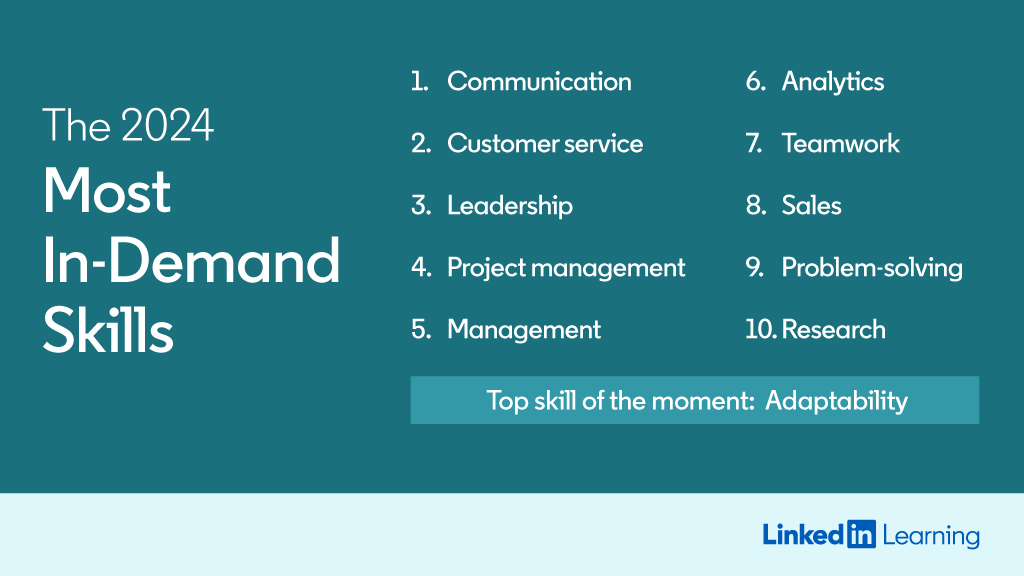
Talent development professionals and executives can help employees stay agile in this new world of work by continuing to help employees build mission-critical soft skills. A recent LinkedIn survey found that 9 out of 10 global executives agree that soft skills (aka “human” or “durable” skills) are more important than ever. So, it’s not surprising that communication ranks No. 1 on the 2024 list of overall most in-demand skills.
Since AI has changed work so profoundly over the last year, we’re also highlighting the top “skill of the moment” with the most notable surge in year-over-year demand: adaptability. It’s an indispensable skill that allows teams and organizations to keep steady and drive maximum impact. And this skill will become even more important as the pace of change only increases. Since 2015, skills for roles have, on average, changed by 25%; by 2030 it’s expected that number will reach at least 65%. Today, more than half of LinkedIn members hold jobs that stand to be disrupted or augmented by AI.
Most in-demand skills for 2024 (plus upskilling resources)
To determine this year’s most in-demand skills, we analyzed data from LinkedIn’s 1 billion members across 200 regions and countries. Our data set illustrates just how rapidly the world of work is changing: over the last 12 months, members have added 680 million skills to their profiles, up 80% year-over-year.
Communication, customer service, and leadership continue to be business-critical skills in the age of AI. And other emerging skills like problem-solving and research showcase the importance of upskilling, reskilling, and adapting to a changing world of work.
1. Communication
In an era of hybrid work, employees communicate across an ever-expanding range of channels and platforms. Since in-person collaboration is no longer the default, effective communication from company and team leadership across channels helps connect, motivate, and inspire your teams.
2. Customer service
AI has already brought about watershed changes in the customer service arena, but there are aspects of this function that cannot and should not be automated. The people-centered aspects of customer service, including cultivating relationships and building trust, are becoming increasingly important.
3. Leadership
Strong leadership pipelines are vital to organizational growth and continuity. And regardless of your position in the org chart, leadership skills continue to be business-critical.
4. Project management
As teams and workflows grow more complex, people leaders and project leaders who can keep everything organized and everyone on the same page are in high demand.
5. Management
The distinction between management and leadership can seem blurry, but it is important to recognize. (“Management is about measurable business outcomes and numbers, while leadership is about the people who create those results,” says LinkedIn Learning instructor Dave Labowitz.) Management skills are versatile and durable, so they’re not going out of style any time soon.
6. Analytics
In an increasingly data-driven world, it’s no surprise to see analytics gaining more prominence. This specialization empowers employees to interpret complex data, derive insights, and make informed decisions swiftly.
7. Teamwork
As teams adapt to new ways of collaborating, they may encounter friction. But finding ways to strengthen teamwork skills remains paramount. Teams that work well together stay adaptive and aligned — and drive tangible results.
8. Sales
The core fundamentals of selling — building relationships and bringing in customers — remain essential in the business world. And in a challenging economy, executives and employees with stellar sales skills stand out, especially those who can use AI tools to aid in the sales cycle.
9. Problem-solving
In the age of AI at work, both leaders and employees will be asked to meet new challenges and solve new problems more often than ever. Applying critical thinking and strategy to challenging problems can help teams thrive.
10. Research
There’s more information out there than ever before, and AI is equipping us with profound new ways to access and use information. “It’s the people who understand how to collaborate with AI that will have a real advantage over the next few years,” says Dave Birss, a LinkedIn Learning instructor, in How to Research and Write Using Generative AI Tools. “When employees fully grasp this, they will be in a strong position to both improve how they do their job today and advance their career moving forward.”
Top skill of the moment
The impact of generative AI has reshaped the world of work more quickly than even experts imagined. To study this phenomenon, we looked at “skills of the moment” — those that grew most quickly in a defined six-month period from 2022 to 2023. One skill rose to the top of the list: adaptability.
Adaptability and agility are mission-critical for both people and organizations. And since the pace of change in the world of work is predicted to increase, adaptability will help your team stay versatile and composed amid these changes. “Adaptability is the best way to have agency right now,” saysAneesh Raman. “At the core of managing change is building that muscle of adaptability.”
Final thoughts
In a world continuously transformed by artificial intelligence, the enduring value of uniquely human skills should be a guiding light for both employees and learning and development departments. As organizations navigate the vast universe of AI capabilities, they will continue to recognize the importance of fostering and prioritizing human-centric skills within their teams. And businesses will reap the benefits of continuous upskilling for the most in-demand skills — from boosting employee retention to helping companies meet and exceed financial targets.
And as LinkedIn’s CEO Ryan Roslansky says: “I believe we are in the early days of a world of work that is more human than before, giving us the chance to do more fulfilling work and to do that work more easily and effectively with others.”
Hỗ trợ các tổ chức xã hội, doanh nghiệp và chính quyền địa phương xây dựng hệ thống quản trị tập trung vào hiệu quả – công bằng – minh bạch – có trách nhiệm. GISA triển khai đào tạo, tư vấn và đồng hành cải tiến mô hình quản trị tổ chức. Chương trình này có thể mang lại nhiều giá trị và lợi ích quan trọng khác nhau cho các doanh nghiệp, tổ chức và xã hội như sau: • Nâng cao năng lực quản trị chiến lược và quản trị rủi ro • Tăng hiệu quả sử dụng nguồn lực và đạt mục tiêu phát triển • Tạo nền tảng bền vững cho tổ chức có ảnh hưởng xã hội
Không gian thử nghiệm mô hình quản trị xanh, trong đó chính quyền địa phương, doanh nghiệp và cộng đồng đồng kiến tạo các chính sách, cơ chế vận hành và sáng kiến phù hợp với nguyên tắc bền vững, tiết kiệm tài nguyên và có tính phục hồi. Sáng kiến này có thể mang lại nhiều giá trị và lợi ích quan trọng khác nhau cho các doanh nghiệp, tổ chức và xã hội như sau: • Thúc đẩy mô hình quản trị địa phương tích hợp môi trường • Tăng cường năng lực chính sách xanh và hành động cộng đồng • Tạo điều kiện nhân rộng mô hình hiệu quả trong các đô thị nhỏ và vùng chuyển tiếp
Hỗ trợ các đô thị và khu công nghiệp xây dựng hệ thống quản trị số hóa, hiệu quả năng lượng, tiết kiệm tài nguyên và thân thiện với môi trường. GISA tư vấn các giải pháp quản lý thông minh về chất thải, nước, không gian công cộng và đô thị xanh. Dự án này có thể mang lại nhiều giá trị và lợi ích quan trọng khác nhau cho các doanh nghiệp, tổ chức và xã hội như sau: • Thúc đẩy chuyển đổi số cho đô thị bền vững • Tăng hiệu quả dịch vụ công và cải thiện chất lượng sống • Giảm chi phí quản lý và tác động môi trường đô thị
GISA xây dựng nền tảng dữ liệu mở và công cụ phân tích hỗ trợ ra quyết định trong quản lý tài nguyên, biến đổi khí hậu, an ninh lương thực và quy hoạch không gian. Đồng thời, đào tạo đội ngũ địa phương sử dụng dữ liệu phục vụ giám sát và cải tiến chính sách. Chương trình này có thể mang lại nhiều giá trị và lợi ích quan trọng khác nhau cho các doanh nghiệp, tổ chức và xã hội như sau: • Cung cấp nền tảng ra quyết định dựa trên bằng chứng • Tăng năng lực quản trị số và giám sát tác động tại địa phương • Thúc đẩy minh bạch và trách nhiệm giải trình
Chương trình phát triển năng lực lãnh đạo xanh – bền vững cho các nhà quản lý doanh nghiệp, cán bộ chính quyền, tổ chức xã hội và thanh niên. GISA tập trung vào kỹ năng lãnh đạo chuyển đổi, xây dựng tầm nhìn dài hạn và thúc đẩy đổi mới vì tác động tích cực. Chương trình này có thể mang lại nhiều giá trị và lợi ích quan trọng khác nhau cho các doanh nghiệp, tổ chức và xã hội như sau: • Hình thành đội ngũ lãnh đạo có tư duy bền vững và hành động có trách nhiệm • Tăng khả năng dẫn dắt thay đổi trong tổ chức và cộng đồng • Kết nối mạng lưới lãnh đạo trẻ, sáng tạo và giàu cảm hứng
About us
29 Nguyen Khac Nhu, Ward Cau Ong Lanh, (District 1), Ho Chi Minh City, Vietnam